Products
TASI Technical Software currently has software tools for the analysis
of small signal piezoelectric properties, and large signal characterisation
of piezoeoelectric, electrostrictive, ferroelectric, and antiferroelectric
materials. Each software package is modular where extended features are
supported through plug-in software modules. Each package also includes
an optional data acquisition module allowing the collection of raw data
directly from instrumentation.
PRAP
(Piezoelectric Resonance
Analysis Program)
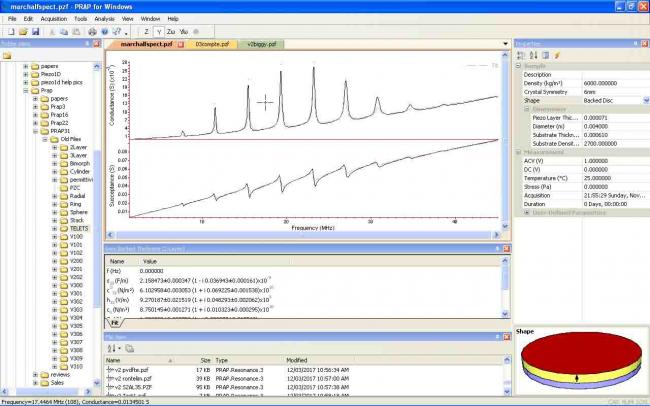
This software package allows the determination of complex elastic, piezoelectric,
and dielectric properties of piezoelectric resonators. Included with analysis
is the computation of components of Van Dyke's circuit model and those
of a complex circuit model. An optional data acquisition module integrates
the collection of resonance spectra from an impedance analyser.
This is a 32 bit Windows application that runs under Windows 95, 98,
NT, 2000, ME, and XP. The Basic PRAP Package includes 7 standard
one-dimensional resonance modes of 6mm (C¥)
symmetry materials. Optional analysis modules add support for other crystal
symmetries and resonance geometries. The Basic Data Acquisition Module
includes drivers for a variety of impedance analysers and temperature
controllers that allow direct acquisition of resonance spectra. PRAP has
file formats for storing a single resonance spectrum and a compound file
that stores a collection of spectra. Optional data acquisition modules
allow a set of resonance spectra to be collected as a function of variables
such as time, DC bias or temperature. These modules allow the study of
such things as electrostrictive or ageing properties of piezeoelectric
materials. A collection of resonance spectra in a compound file can also
be used to compute the complete piezoelectric matrix of a material.
ZAP
(Impedance Analyser
Program)
This software package incorporates all the features of the PRAP Basic
Data Acquisition Module into a stand-alone application, allowing direct
acquisition of resonance spectra from an impedance analyser. Beyond the
graphical display of data, it does not include any of the analysis modules
available with PRAP. This package should be of interest to those that
are not interested in performing resonance analysis of electromechanical
resonance spectra, but are interested in an simple automated way of collecting,
viewing, and archiving the electrical properties (such as impedance or
admittance) of a sample as a function of frequency.
This is a 32 bit Windows application that runs under Windows 95, 98,
NT, 2000, ME, and XP. Included with the package is the Basic Data
Acquisition Module of PRAP that includes drivers for a variety of impedance
analysers and temperature controllers. This allows direct acquisition
of sample impedance, admittance, etc. as a function of frequency. Optional
data acquisition modules allow a set of impedance or admittance spectra
to be collected as a function of time, DC bias, or temperature into a
PRAP Compound File. Acquired spectra can be exported to ASCII text files
or copied to the Windows clipboard to be pasted into other Windows applications.
The data can be transformed into a variety of representations (such as
impedance, admittance, etc.), and can be displayed in a Locus Plot.
STEP
(Electromechanical Response Characterisation Program)
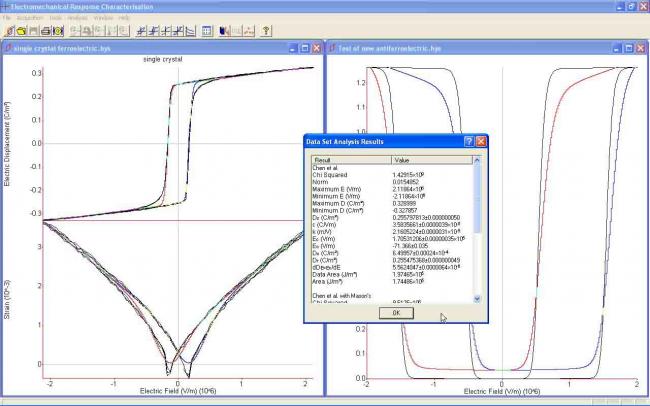
This software package allows the large signal electromechanical characterisation
of piezoelectric, electrostrictive, ferroelectric, and antiferroelectric
materials. The name of the package refers to the four parameters of an
electromechanical measurement;
(S) Strain
(T) Stress
(E) Electric Field
(P) Polarisation or Electric Displacement
This is a 32 bit Windows application that
runs under Windows 95, 98, NT, 2000, ME, and XP. The Basic STEP
Package includes sets of large signal analysis models for piezoelectric,
electrostrictive, ferroelectric, and antiferroelectric materials. Optional
analysis modules add more specific and specialised models of analysis.
The Basic Data Acquisition Module of STEP allows the electromechanical
response of a sample to be measured using a variety of instruments. In
principle, these measurements can be electric field-controlled, electric
displacement-controlled, stress-controlled, or strain-controlled, depending
on the instrumentation available. Additional optional data acquisition
modules allow electromechanical response to be measured as a function
of time, temperature, etc. |